Why Are Indians So Prone to Diabetes? What Famine and the Womb Tell Us


"History can explain part of why Indians get diabetes at a lower weight. It cannot decide your future. Build muscle, put protein on every plate and test early, and you change the part that is in your hands." - Dt. Trishala Goswami, MSc Clinical Nutritionist, Diabetes Educator
Reviewed by Dt. Trishala Goswami, MSc Clinical Nutritionist · Diabetes Educator · Certified Nutrigenomics Specialist · Last Updated: October 2026
The short answer: Indians tend to develop type 2 diabetes at a younger age and a lower weight than many other groups, often while looking slim (Wells et al., 2016). One idea that may explain part of this is the "thrifty phenotype": a baby that grows short of nutrition in the womb adapts by building less muscle and smaller organs while holding on to fat, and that body copes worse with plenty later in life. Studies of famines in the Netherlands, China and Ukraine show people exposed to famine before birth have a higher risk of diabetes. Whether India's own famines shaped today's diabetes problem has not been proven, and in the countries studied, famine exposure accounts for only about 1 in 100 cases. Your daily habits matter far more.
If you are slim and have been told your sugar is creeping up, or you have PCOS and "you are not even overweight", this is a question worth asking. The answer is not one thing. Genes, diet, activity, sleep and the way Indian bodies store fat all play a part. This article looks at one piece of the puzzle that is rarely explained: what happens before we are born, and why India's history makes that question so personal.
India lived through famine after famine
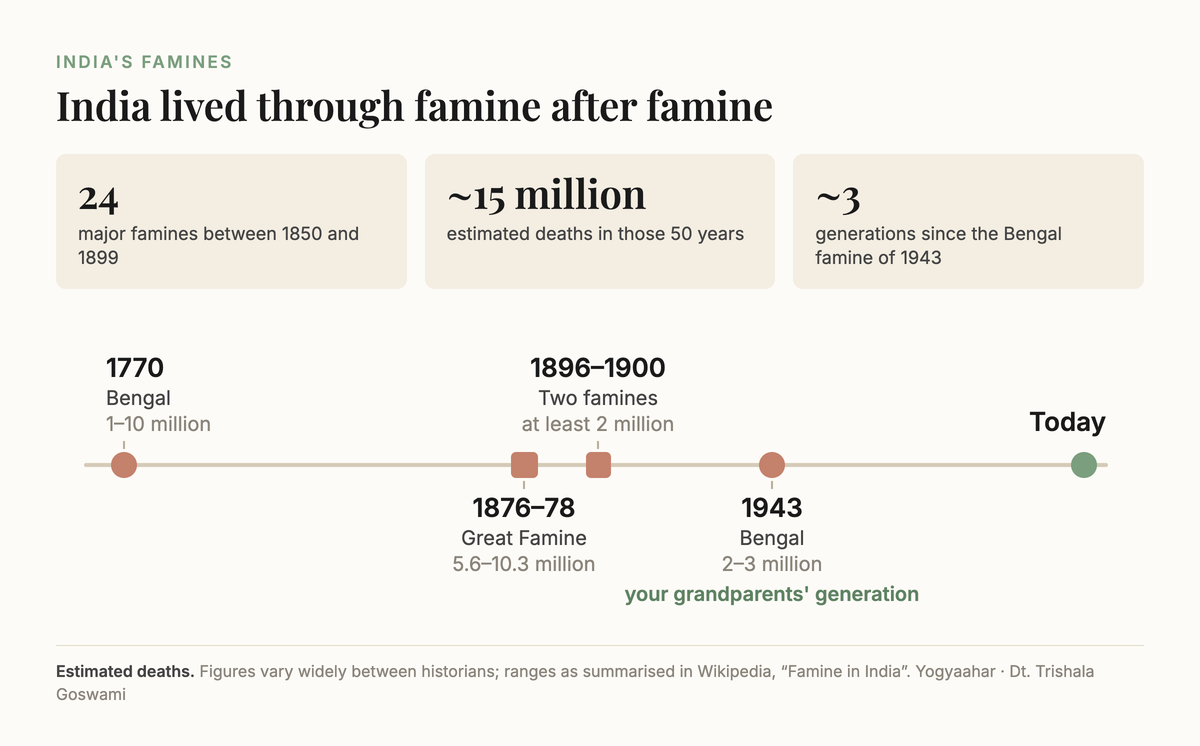
Between 1770 and 1943, famine struck India again and again. Historians estimate that about 15 million people died in 24 major famines between 1850 and 1899 alone, more than in any other 50-year period (Famine in India).
The best-known famines include:
- Bengal, 1770: estimates range from 1 to 10 million deaths (Famine in India).
- The Great Famine, 1876 to 1878: at least 5.6 million deaths, with some estimates as high as 10.3 million (Famine in India).
- 1896 to 1900: two famines, one in 1896 to 1897 and one in 1899 to 1900, each with more than a million deaths (Famine in India).
- Bengal, 1943: estimates range from 0.8 to 3.8 million deaths; the historian Cormac Ó Gráda puts the scholarly consensus at about 2.1 million. It happened in wartime: historians point to lost rice imports after the Japanese occupation of Burma, British "denial" and inflation policies, and a cyclone and crop disease that hit the rice harvest (Bengal famine of 1943).
Death tolls from this period are uncertain, and historians disagree on the numbers. What is not in doubt is the scale. The Bengal famine of 1943 is only about three generations ago: for many families, it is the world our grandparents or great-grandparents were born into.
What famine does to a baby in the womb
In 1992, two British researchers, Nick Hales and David Barker, put forward an idea they called the thrifty phenotype (Hales and Barker, 1992). "Phenotype" simply means how the body is built and works, as opposed to the genes it carries.
Their idea, in plain terms:
- When a baby gets too little nutrition in the womb, it adapts to survive.
- It protects the brain and puts less into muscle and some organs, possibly including the pancreas, which makes insulin.
- Those changes help in a world of scarcity. But if the same person later lives with plenty of food and little physical work, the body copes poorly, and the risk of type 2 diabetes rises.
The key word is development, not genes. The thrifty phenotype describes how a body is shaped by its first nine months, not a gene that was passed down from famine survivors. How much genes add on top of this is still debated (Hales and Barker, 2001).
The evidence: three famines, one pattern
This idea cannot be tested by experiment. Instead, researchers have studied people who were in the womb during three well-recorded famines.
The Dutch Hunger Winter, 1944 to 1945. In 702 adults, those exposed to famine before birth had higher blood sugar two hours after a glucose drink. The average was 5.8 mmol/L in people who were not exposed, and 0.5 mmol/L higher in those exposed in late pregnancy. Levels were highest in people born thin to mothers with low body weight, and especially high in exposed people who became obese as adults. Their insulin results suggested insulin resistance (Ravelli et al., 199807244-9)).
China, 1959 to 1961. In 7,874 rural adults, 2.4% of people not exposed to famine had high blood sugar, against 5.7% of those exposed in the womb. In the areas hit hardest, exposure before birth was linked to about 3.9 times the odds of high blood sugar; in less affected areas, no increase was seen (Li et al., 2010).
Ukraine, 1932 to 1933. Comparing 43,150 people with type 2 diabetes against 1,421,024 people born between 1930 and 1938, those born in the first half of 1934 in regions of extreme famine had about 1.5 times the odds of type 2 diabetes. The effect was smaller in regions of severe famine and absent where there was no famine. The worse the famine, the higher the risk (Lumey et al., 201500279-X)).
Three famines, three countries, one consistent pattern: being in the womb during famine is linked to higher diabetes risk later in life. The China studies have been questioned on how exposed and unexposed groups were defined, because age differences between groups can look like a famine effect (Li et al., 2019). Studies that compare people born at the same time in famine and non-famine regions, like the Ukrainian study, are less affected by this problem.
Closer to home: the thin-fat Indian baby
No study has measured what India's historical famines did to diabetes risk. But one Indian study shows something closely related happening in ordinary pregnancies, with no famine at all.
The Pune Maternal Nutrition Study compared 631 babies born in rural villages near Pune with 338 babies born in Southampton, UK (Yajnik et al., 2003). The Pune babies weighed 2.7 kg on average at birth, against 3.5 kg in Southampton. They were smaller on every measure, but not equally so.
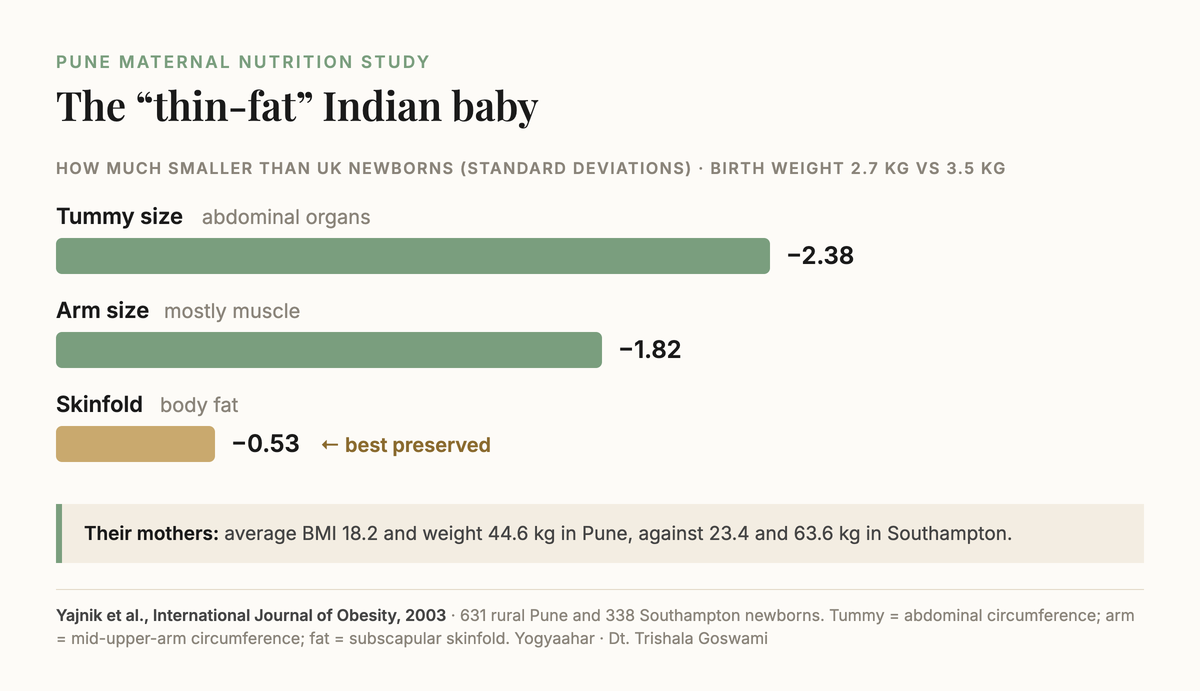
- Their tummies (abdominal circumference) were the most reduced, a sign of smaller abdominal organs.
- Their arms (mid-arm circumference) were also much smaller, a sign of less muscle.
- Their body fat (the skinfold under the shoulder blade) was the best preserved.
The researchers concluded that small Indian babies have small abdominal organs and low muscle mass but hold on to body fat, and that this body composition may persist and predispose them to insulin resistance. The mothers tell the rest of the story: an average BMI of 18.2 and weight of 44.6 kg in Pune, against 23.4 and 63.6 kg in Southampton.
This is the thin-fat Indian baby: light at birth, with less muscle, but not less fat. It fits the pattern the thrifty phenotype describes, seen in a generation born long after the famines ended. Undernutrition in mothers did not end with the last famine.
Thin outside, fat inside: what it means for adults
The thin-fat pattern does not stay in the cot. An Indian expert consensus notes that Asian Indians tend to carry more body fat and more fat around the abdomen at the same BMI, which is why the healthy BMI range for Indians is lower and narrower than for white Europeans (Misra et al., 2009). We explain this in detail in why Indians get diabetes at a lower weight.
In practice, this means the usual cut-offs under-read risk for Indians. The UK's NICE guideline (NG246) uses lower BMI thresholds for people of South Asian, Chinese, other Asian, Middle Eastern, Black African or African-Caribbean background, and a waist-to-height cut-off that applies to everyone:
| Measure | General cut-off | South Asian cut-off |
|---|---|---|
| BMI, overweight | 25 | 23 |
| BMI, obesity | 30 | 27.5 |
| Waist-to-height ratio, increased risk | 0.5 or more | 0.5 or more (same for all ethnicities) |
You can check yours with our BMI calculator and waist-to-height ratio calculator. The simple rule: keep your waist under half your height.
Built for scarcity, living in plenty
The thrifty phenotype has a second half that matters most for anyone reading this today: the risk is highest when a body built for scarcity meets plenty.
The studies point the same way, though the China figures are imprecise and that study's design has been questioned. In China, people exposed to severe famine in the womb who later ate an affluent, Western-style diet had about 7.6 times the odds of high blood sugar, and those with a higher economic status in adult life about 6.2 times (Li et al., 2010). In the Dutch study, blood sugar was especially high in exposed people who became obese (Ravelli et al., 199807244-9)).
One way to picture this is the "capacity and load" model (Wells et al., 2016). Your metabolic capacity, such as how much insulin your pancreas can make and how much glucose your muscles can clear, may be set lower from birth. The load comes from belly fat, refined carbohydrates and long hours of sitting. Blood sugar rises when the load outgrows the capacity, which is why a slim person with little muscle can still be at risk.
India has changed fast. Within one or two generations, many families have moved from physical work and simple food to desk jobs, cars, refined flour, sugar and packaged snacks. For Indians who have moved abroad, the change is often sharper still: bigger portions, more takeaway and less walking. If the thrifty phenotype idea is right, this mismatch, not the famine itself, is where the risk shows up.
How much does this really explain?
This is the most important section, so it is worth being precise.
A 2024 study pulled together the data from the Ukrainian, Dutch and Chinese famines to estimate their effect on whole populations. Famine exposure before birth was linked to about 21,000 extra type 2 diabetes cases in Ukraine, 400 in the western Netherlands and 0.9 million in China. That sounds large, but it represented only around 1% of all type 2 diabetes cases in those countries (Li, Ó Gráda and Lumey, 2024).
So, three honest conclusions:
- For an individual exposed in the womb, the extra risk is real in the famines that have been studied.
- For a population, it is a small slice of the problem. In the countries studied, about 99 in 100 cases of type 2 diabetes had other causes.
- For India, it is a hypothesis. Some researchers have proposed that regular famines and the undermining of food security during the colonial period contributed to diabetes risk in India (Wells et al., 2016), but no study has measured this directly. It is a plausible part of the story, not a proven cause.
History is not destiny: what you can do
You cannot change what happened before you were born. You can change almost everything that decides whether that early risk ever turns into diabetes, and the same levers help whether or not famine played any part in your family's story.
- Build and keep muscle. Muscle is where your body stores much of its glucose, and the thin-fat body is short of it. Strength training two to three times a week, with bodyweight, bands or weights, is one of the most direct ways to build it.
- Put protein on every plate. A typical vegetarian Indian meal of dal, rice, sabzi and roti is often light on protein. Add a katori of curd, paneer, eggs, soya chunks, chicken or fish, or more dal, to every meal. Our protein calculator gives you a daily range, and our list of high-protein vegetarian foods helps you reach it.
- Watch your waist, not just the scale. Keep your waist under half your height. A slim person can still carry risk around the middle.
- Test early, and test the right things. Ask your doctor about HbA1c and fasting insulin, not only fasting glucose. Fasting insulin, together with fasting glucose, gives your HOMA-IR, which can show insulin resistance before blood sugar rises. Try our HOMA-IR calculator and read about the signs of insulin resistance.
- Cut the biggest spikes. Sugary drinks, sweets, refined flour and packaged snacks raise blood sugar fastest. Swap rather than ban: whole grains, dals and vegetables first, and refined foods in smaller amounts.
- Look after the next generation. If the thin-fat baby begins in the womb, good nutrition before and during pregnancy matters. If you are planning a family, talk to your doctor about nutrition, folate and vitamin B12 early.
If you have PCOS, a family history of diabetes or a slim build with rising sugar, these steps matter more, not less. You can also check your own risk with our diabetes risk score.
Related reading
- Why Indians get diabetes at a lower weight
- HOMA-IR explained: Indian cut-offs and how to bring it down
- HbA1c explained: what your numbers really mean
- PCOS and insulin resistance: the hidden connection
- Fatty liver diet for Indians
References
- Hales CN, Barker DJ. Type 2 (non-insulin-dependent) diabetes mellitus: the thrifty phenotype hypothesis. Diabetologia. 1992;35(7):595-601. doi:10.1007/BF00400248
- Ravelli AC, van der Meulen JH, Michels RP, et al. Glucose tolerance in adults after prenatal exposure to famine. Lancet. 1998;351(9097):173-7. doi:10.1016/S0140-6736(97)07244-907244-9)
- Yajnik CS, Fall CH, Coyaji KJ, et al. Neonatal anthropometry: the thin-fat Indian baby. The Pune Maternal Nutrition Study. Int J Obes Relat Metab Disord. 2003;27(2):173-80. doi:10.1038/sj.ijo.802219
- Li Y, He Y, Qi L, et al. Exposure to the Chinese famine in early life and the risk of hyperglycemia and type 2 diabetes in adulthood. Diabetes. 2010;59(10):2400-6. doi:10.2337/db10-0385
- Lumey LH, Khalangot MD, Vaiserman AM. Association between type 2 diabetes and prenatal exposure to the Ukraine famine of 1932-33: a retrospective cohort study. Lancet Diabetes Endocrinol. 2015;3(10):787-94. doi:10.1016/S2213-8587(15)00279-X00279-X)
- Li C, Tobi EW, Heijmans BT, Lumey LH. The effect of the Chinese Famine on type 2 diabetes mellitus epidemics. Nat Rev Endocrinol. 2019;15(6):313-4. doi:10.1038/s41574-019-0195-5
- Li C, Ó Gráda C, Lumey LH. Famine mortality and contributions to later-life type 2 diabetes at the population level: a synthesis of findings from Ukrainian, Dutch and Chinese famines. BMJ Glob Health. 2024;9(8):e015355. doi:10.1136/bmjgh-2024-015355
- Misra A, Chowbey P, Makkar BM, et al. Consensus statement for diagnosis of obesity, abdominal obesity and the metabolic syndrome for Asian Indians. J Assoc Physicians India. 2009;57:163-70. PubMed 19582986
- National Institute for Health and Care Excellence. Overweight and obesity management (NG246). 2025. nice.org.uk/guidance/ng246
- Hales CN, Barker DJ. The thrifty phenotype hypothesis. Br Med Bull. 2001;60:5-20. doi:10.1093/bmb/60.1.5
- Wells JC, Pomeroy E, Walimbe SR, Popkin BM, Yajnik CS. The elevated susceptibility to diabetes in India: an evolutionary perspective. Front Public Health. 2016;4:145. doi:10.3389/fpubh.2016.00145
- Famine in India; Bengal famine of 1943. Wikipedia (accessed 29 October 2026). Death tolls are historians' estimates and vary widely.
This article is general health education and is not a substitute for medical care. Diabetes is diagnosed and treated by your doctor. For personalised nutrition support, book a consultation with Dt. Trishala Goswami.
Slim, but your sugar or your waist is creeping up? Book a consultation with Dt. Trishala Goswami for a plan built around your own reports, or start with our diabetes management program.
Frequently asked questions
Are Indians genetically prone to diabetes?
Genes play a part, as they do in every population, but how much they add is still debated. The "thrifty phenotype" idea, where the body is shaped by nutrition before birth, has been supported by studies around the world, although the strength of the link varies ([Hales and Barker, 2001](https://doi.org/10.1093/bmb/60.1.5)). Today's lifestyle decides much of what happens next.
Did the Bengal famine cause diabetes in Bengalis today?
That has not been proven. Studies of famines in the Netherlands, China and Ukraine show that people exposed in the womb have a higher risk of diabetes, but no study has measured this for the 1943 Bengal famine or any other Indian famine.
What is the thin-fat Indian baby?
It describes a pattern found in the Pune Maternal Nutrition Study: Indian babies were lighter at birth than UK babies, with smaller abdominal organs and less muscle, but their body fat was relatively preserved. The researchers suggested this body composition may persist and predispose to insulin resistance.
If my grandparents lived through a famine, will I get diabetes?
Not because of the famine alone. Famine may nudge risk for people who were themselves in the womb at the time, but in the famines studied it explained only about 1% of type 2 diabetes cases. Muscle, protein, waist size, sleep and early testing matter far more for your own risk.
What should slim Indians do to lower their diabetes risk?
Build muscle with strength training two to three times a week, eat protein at every meal, keep your waist under half your height, cut sugary drinks and refined snacks, and ask your doctor for HbA1c and fasting insulin tests rather than fasting glucose alone.
MSc Clinical Nutritionist · Diabetes Educator · Certified Nutrigenomics Specialist
Dt. Trishala Goswami is a clinical nutritionist and certified diabetes educator who designs personalized, science-backed nutrition programs for clients across India and abroad. She specializes in diabetes, PCOS, gut health, and nutrigenomics.
More about Dt. TrishalaWant a personalised Diabetes plan?
Articles can’t replace personalised care. Book a 30-min consultation with Dt. Trishala.
Living outside India? See how online consultations work for NRIs & global clients →
Related reads
Diabetic Meal Plan: 7-Day Indian Menu for Type 2 Diabetes
A full week of Indian meals for type 2 diabetes, built on the Diabetes Plate method. Vegetarian menus with egg and non-veg swaps, hand and katori portions, snacks, chai and fruit, eating order, how to check the plan is working in mg/dL and mmol/L, and a grocery list for Indians c
Insulin Resistance Symptoms: The Signs, the Tests, and Why Indians Should Look Closer
Dark skin patches, a growing waist, PCOS, or simply nothing at all. A clear guide to insulin resistance symptoms, which signs are well proven and which are not, why Indians often develop it at a normal weight, and the blood tests that actually tell you.
Diabetes and Kidney Disease: An Indian Diet Guide for Both
Diabetes is the leading cause of kidney disease, yet the two diets contradict each other on rice, dal, millets and protein. A clinical nutritionist explains how to manage both on an Indian plate - and why the renal rules usually win.